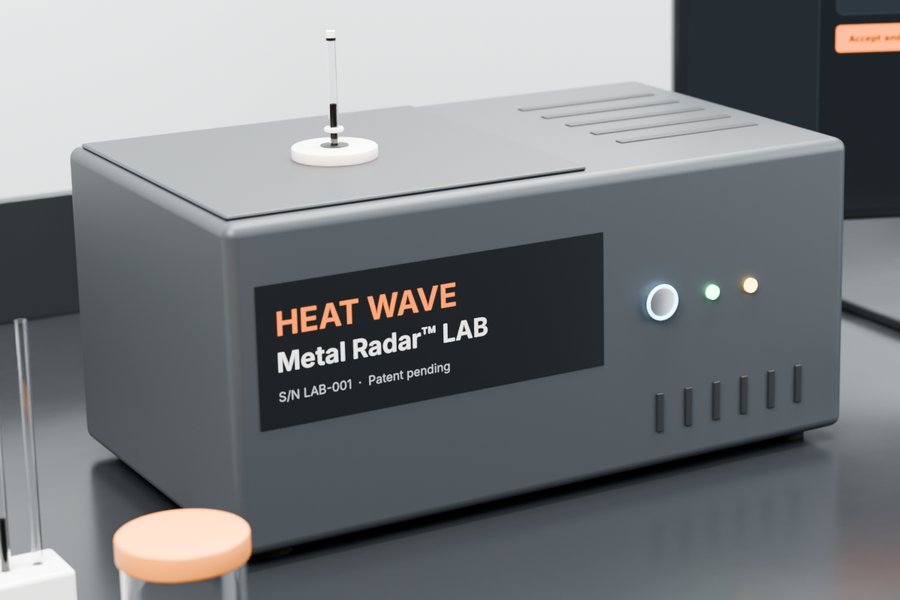
LabBench instrument for your laboratory; the reference model
A weighed sample, read by the Metal Radar microwave sensor. Result in about a minute.
Available January 2027 See specifications →Benchtop microwave analyzer · DRI and HBI · Available January 2027
Metal Radar™ Lab tells you how much metal is really in your DRI or HBI, from one sample in about a minute. No wet chemistry, no X-rays, no radioactive source.
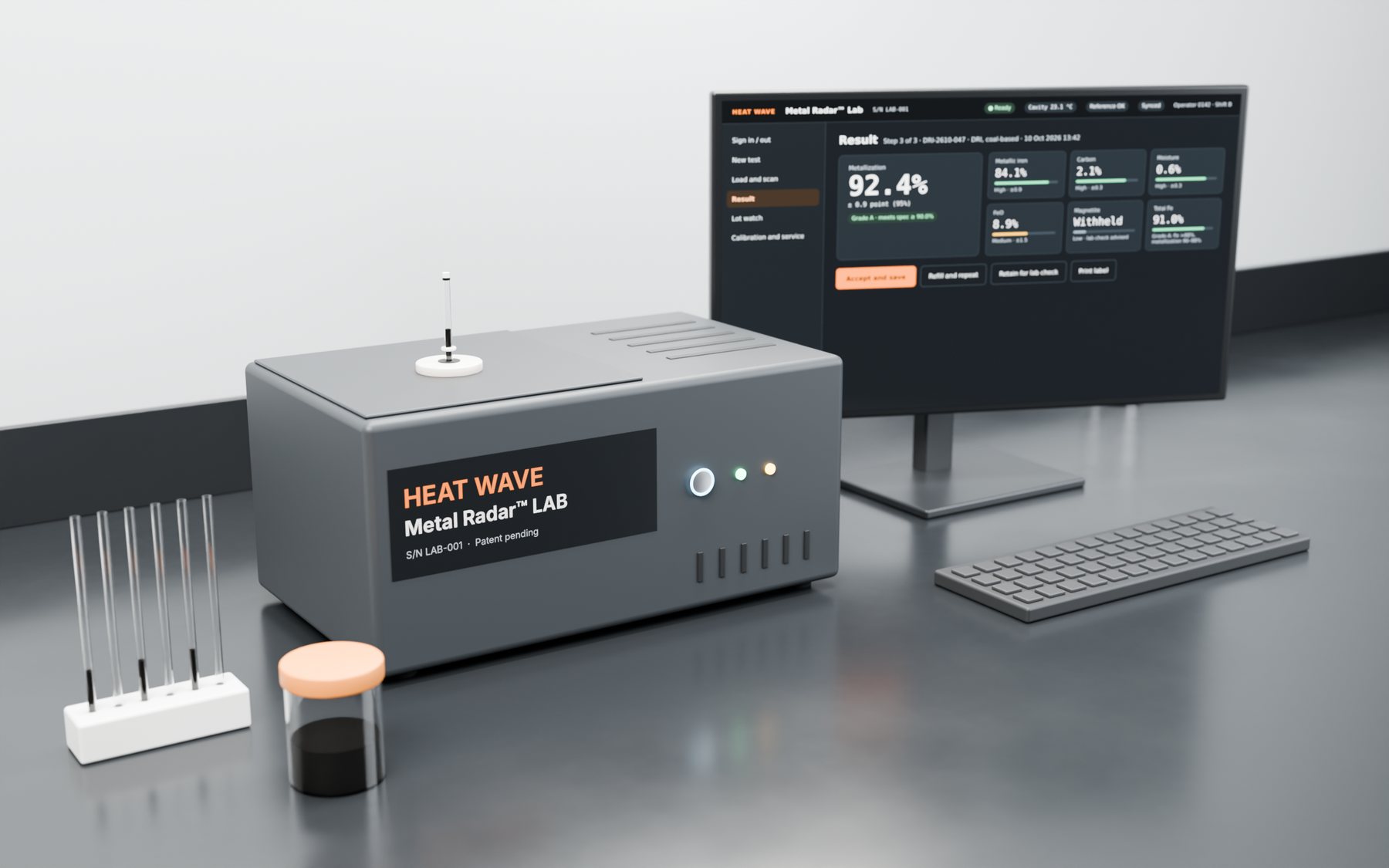
Video demonstration
Load the sample, run the scan, then read every measurement on one screen. The scan is shortened in the video; at the bench it takes about a minute.
What it measures
Each number below is one someone already buys on, argues over or loses money on. Today most take a separate lab method and hours to days. Each result comes with its uncertainty, and a value the unit is unsure of is withheld, not guessed.
| Measure | What it tells you | Why it matters | Replaces |
|---|---|---|---|
| MetallizationDRI, HBI | Share of the iron that is metal, not oxide | DRI is bought and sold on it; low metallization costs a melt shop power, time and yield. | ISO 5416 titration, hours |
| Total iron and DRI grade | Iron content and Grade A, B or C | Price follows grade. The grade is reported on every test. | Titration, hours |
| CarbonDRI, usually 1–4.5% | Carbon content | The second number on every DRI specification: melt shops buy carbon for energy and slag foaming. | Combustion analyzer |
| Moisture | Water in DRI, HBI, scale or coal | Wet DRI reoxidizes and gives off hydrogen; buyers pay for dry tonnes. Measuring water also sharpens every other number. | Oven drying (ISO 3087), hours |
| FeO and magnetite | How far reduction went, and where it stalled | Process control for DRI plants and kilns; explains low metallization. | Titration; magnetic balance |
| Metallization over time | The same lot re-tested in storage or before shipping | Catches value loss and hydrogen risk before a cargo is loaded or charged. | Lab assay at load and discharge only |
Accuracy is confirmed per material in pilot calibration against reference laboratories. Mill scale and EAF dust calibrations are in development.
DRI grade on every test
Metal Radar™ measures metallic iron and metallization together, so total iron follows directly: total Fe = metallic Fe ÷ metallization. Try your own numbers.
| Grade | Total Fe, % | Metallization, % |
|---|---|---|
| A | 88 and above | 90–98 |
| B | 80–86 | 84–90 |
| C | below 80 | below 84 |
How it works
Metal and oxide respond to microwaves very differently. Metal Radar reads that difference in a small sample and turns it into metal, carbon, moisture and oxide.
A small crushed sample goes in. The balance sends the weight; the console loads the right calibration for the material.
One press runs the scan in about a minute. Every reading is corrected for temperature.
Metallization in large type with its uncertainty and the spec decision, plus metallic iron, carbon, moisture and FeO. Every result is saved with operator, unit and calibration version.
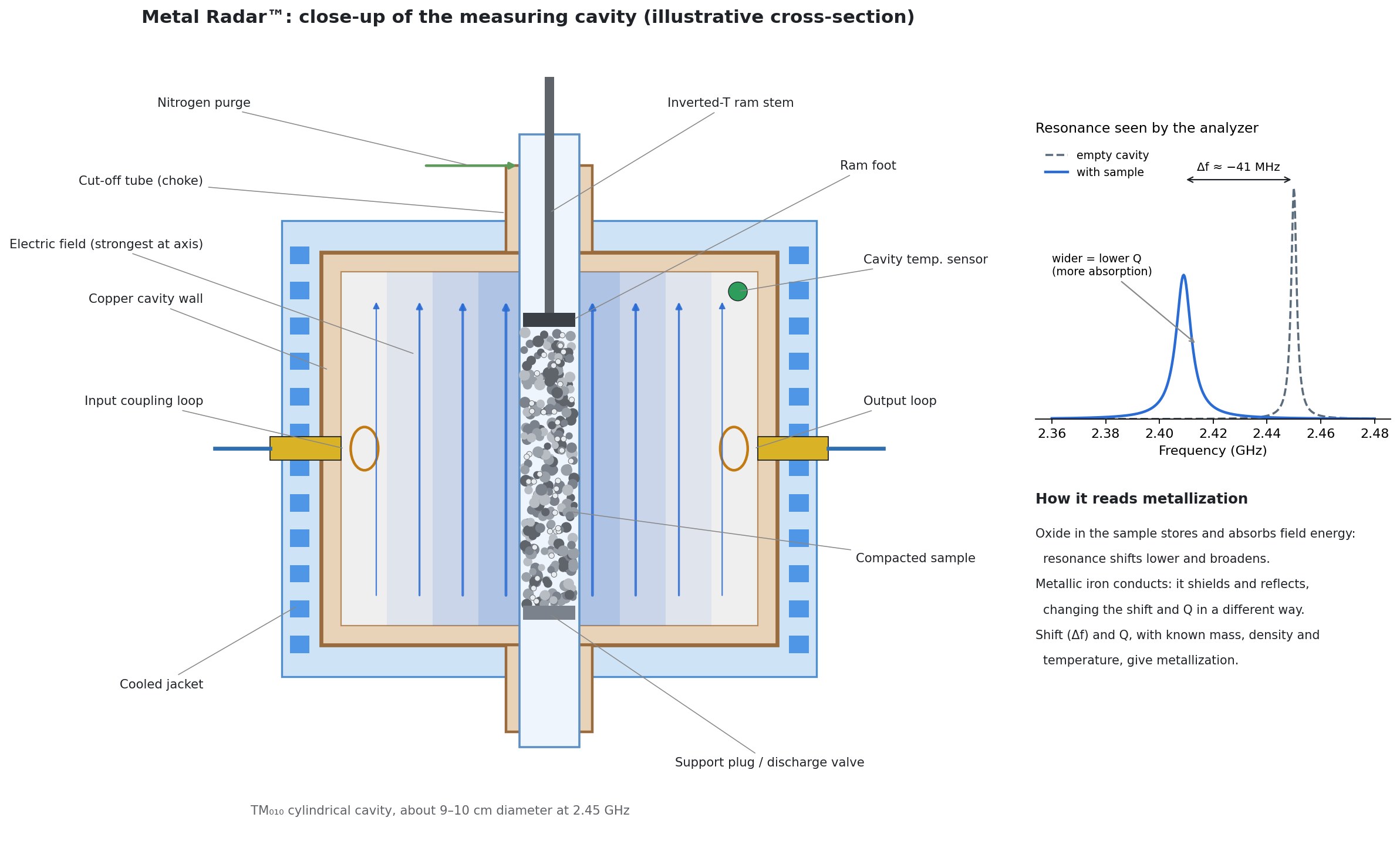 Click to enlarge
Compared with other methods
Other fast methods measure total elements or magnetic metal only. Metal Radar™ separates metal from oxide.
| Method | What it gives | Time | Limits |
|---|---|---|---|
| Wet chemistry, combustion, drying | Metallic iron, carbon, moisture, separately | Hours to days | Three methods; results arrive after the decision |
| Benchtop X-ray diffraction | Crystalline phases, including metallic iron | Minutes plus preparation | Fine grinding and a pressed surface; reads a thin layer; X-ray tube; no moisture |
| XRF, handheld or online | Total iron and other elements | Minutes | Cannot tell metal from oxide; surface only |
| Magnets | Magnetic metal | Minutes | Confused by magnetite; no metallization |
| Neutron conveyor analyzers | Total elements through the burden | Continuous | Total, not metallic; radiation licence; high cost |
| Melt test | Recoverable metal | Days | Large sample, slow, costly |
| Metal Radar™ Lab | Metallization, total iron and grade, carbon, moisture, FeO | About 1 minute | Calibration per material |
Who it's for
World DRI output reached a record 140.8 million tonnes in 2024 (Midrex). Every tonne of it is bought, stored, shipped and charged on numbers that take a lab hours to produce.
Metallization, carbon and moisture every shift, gas or coal based.
Faster process correction; fewer off-spec lots.
Check each delivery of DRI, HBI or pig iron before charging.
Pay for the iron units received; fewer furnace surprises.
Metallization and moisture in yards and stockpiles, before loading and at discharge.
Early warning of reoxidation and heating.
Metal, carbon and moisture in kiln feed and residues.
Better kiln control and residue grading.
Product line
Calibrate with Lab, then install Inline at the plant; Field takes the measurement on site. All share one calibration database, so each new site improves every unit.
A weighed sample, read by the Metal Radar microwave sensor. Result in about a minute.
Available January 2027 See specifications →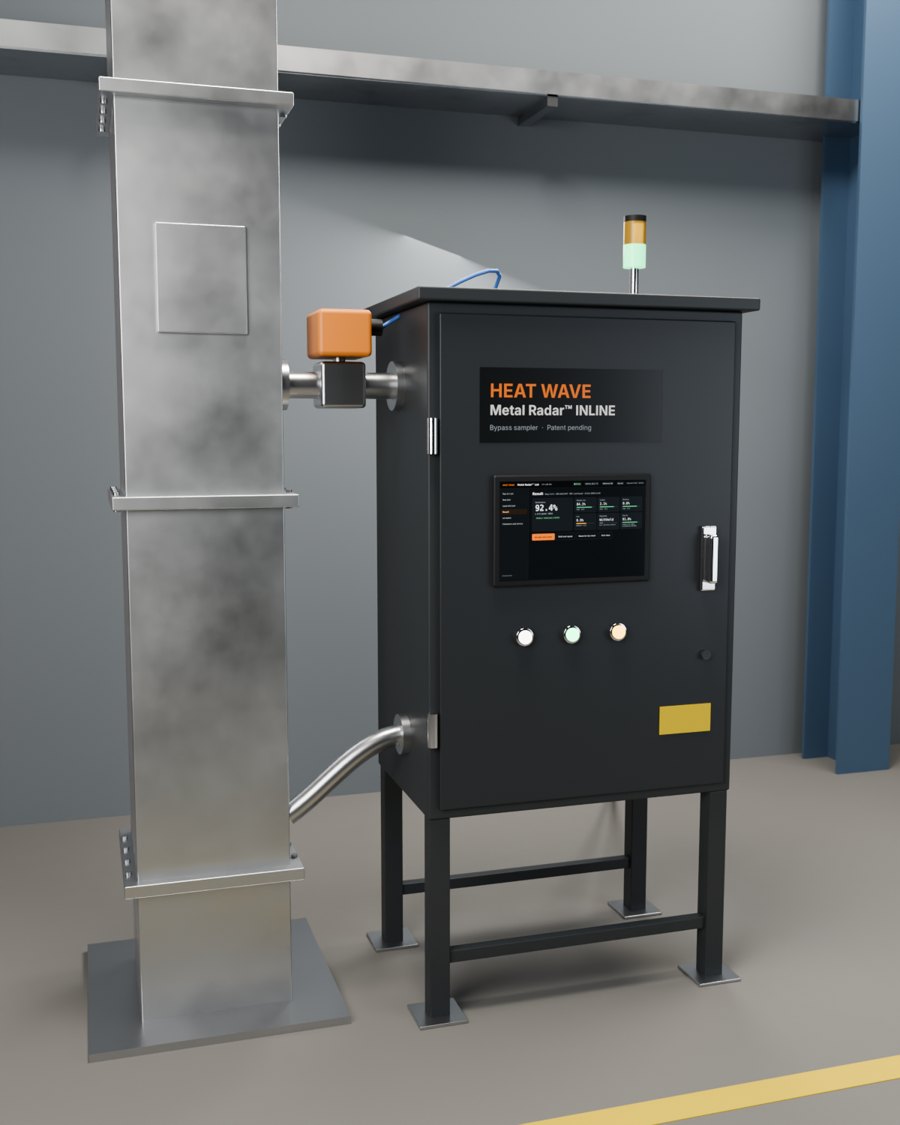
Draws a sample every few minutes from the DRI product stream, reads it and returns it, so operators can trim the process.
Concept · pilot program from January 2027 Watch how it works →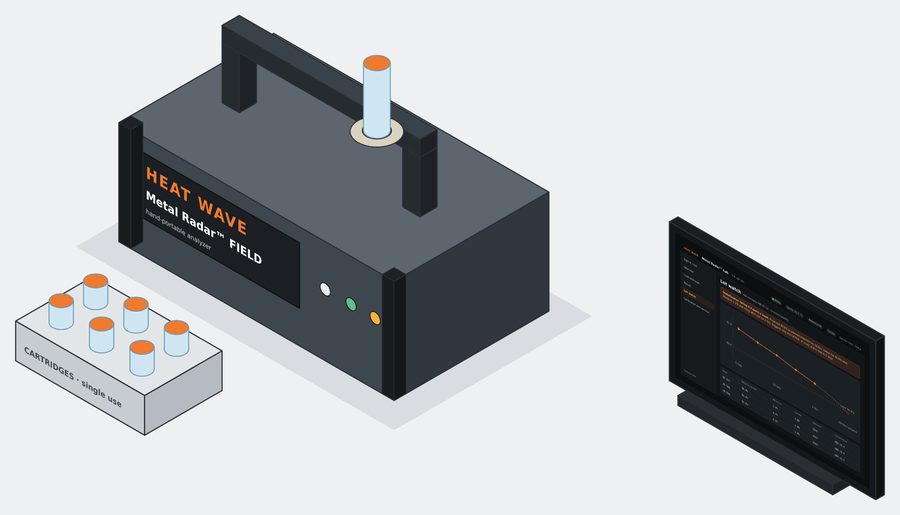
A handheld version of the Metal Radar measurement, for quick readings on site rather than in the lab.
In development Read more →Pictures are illustrations. Only the Lab model has fixed dimensions.
Metal Radar™ Inline · concept
A cabinet beside the cold DRI conveyor that samples, reads and returns material automatically, so operators can trim reducing gas and cooling-zone carbon instead of grading the product after the fact.
Concept Follows the Lab and uses its calibrations. Technical brief (PDF)
↑ Back to modelsMetal Radar™ Field · in development
A handheld version of the Metal Radar measurement, for quick readings on site rather than in the lab. Applications and availability will be announced as development progresses.
In development Ask about Field
↑ Back to modelsLab specifications
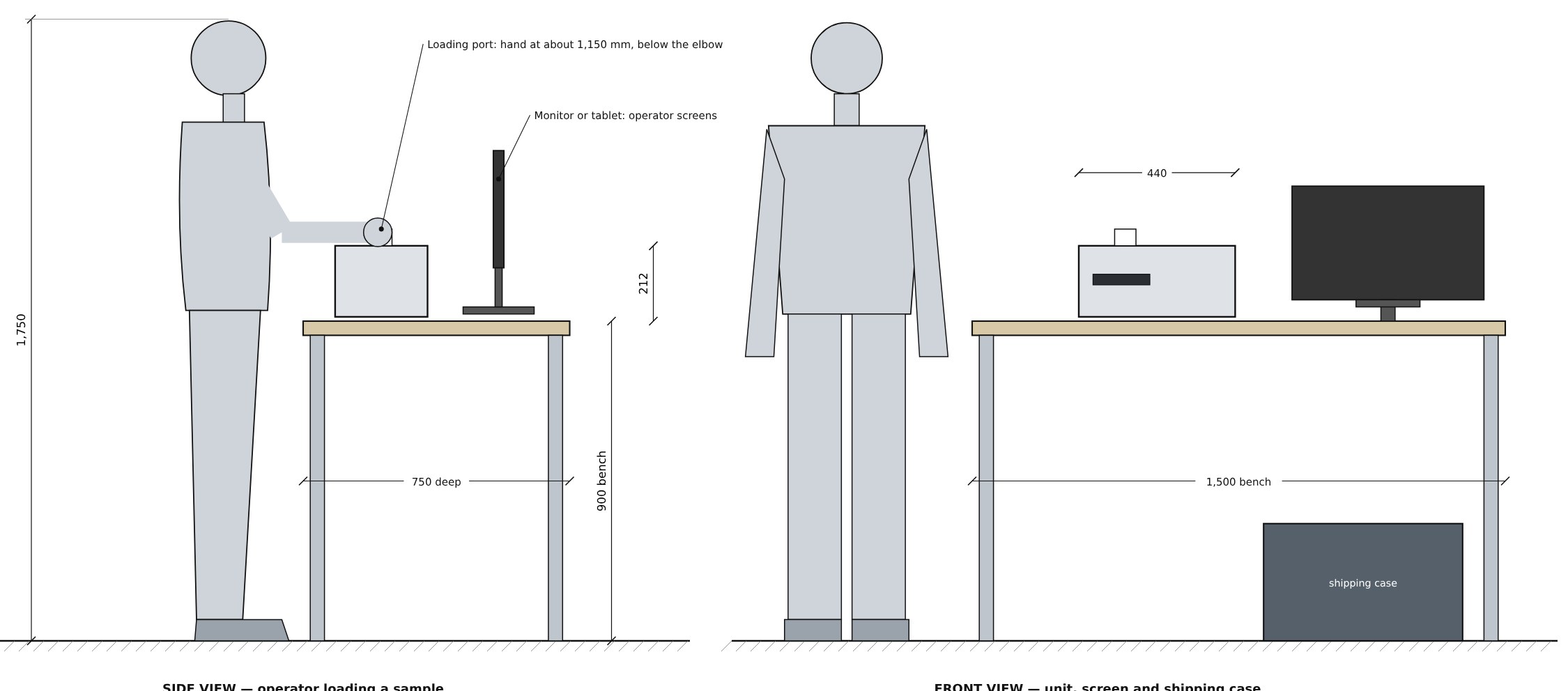
The unit takes about a third of a standard 5 ft bench, with its screen beside it. It works offline and syncs records when connected, over an outbound-only encrypted link that site IT can approve.
 Click to enlarge
To scale: a 5 ft 9 in (1,750 mm) operator at a standard 36 in (900 mm) bench. The loading port sits just below the elbow; the unit takes about a third of a 5 ft bench, with the screen beside it and the shipping case underneath.
| Size | 17.3 × 10.2 × 7.9 in (W × D × H); about 20 lb |
| Sample | A small crushed sample; preparation set per material in the pilot |
| Time per test | About 60 s scan; about 3 minutes at the console |
| Measurement | Metal Radar microwave sensor (design proprietary), corrected for temperature |
| Microwave power | About 1 milliwatt; no shielding, licence or radiation source |
| Power and connections | 19 V DC external supply (100–240 V AC); Ethernet, Wi-Fi, USB balance |
| Environment | Indoor lab, 59–86 °F |
Design targets, to be confirmed in pilot tests.
About Heat Wave
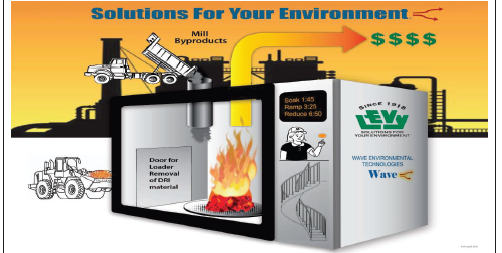
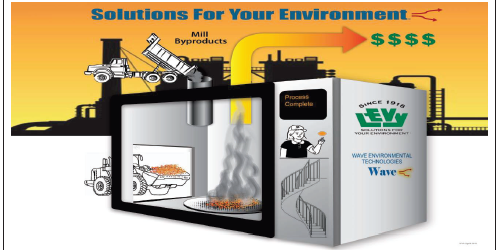
Heat Wave, of Colorado Springs, Colorado, develops microwave technology for the iron and steel industry. Metal Radar™ is built on 25 years of putting microwaves to work in real plants.
See it, then test it on your material
The pilot program starts in January 2027. A small number of early sites will receive a unit for side-by-side tests against their own laboratory, on loan or at cost, in exchange for the side-by-side data and a reference. No subscription during the pilot.